Back
Changing your ERP system. When is it time to implement Microsoft Dynamics 365?
September 8, 2026
INSIGHT
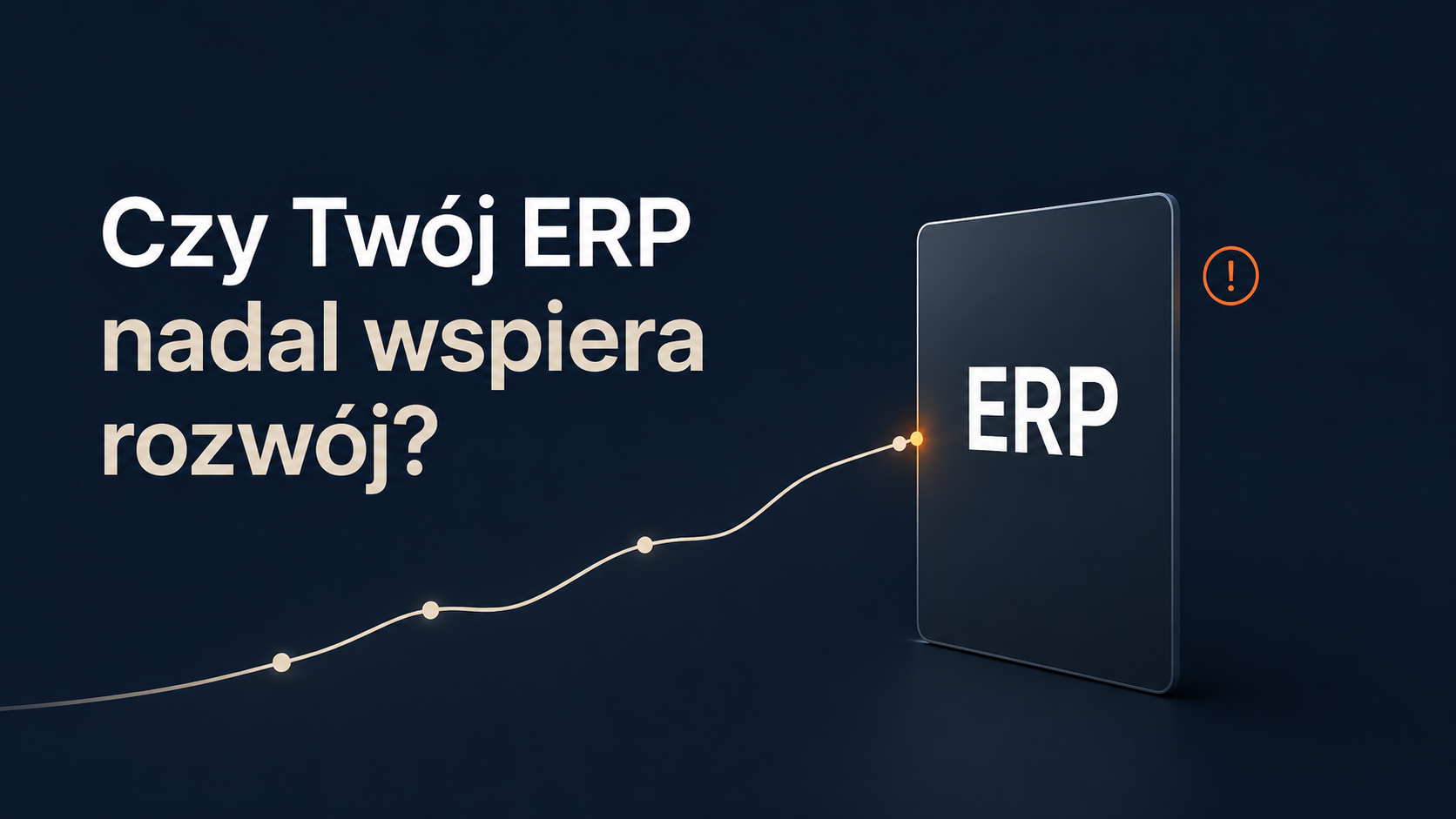
It is very rare for companies to wake up one day and think: "it's time to implement a new ERP system."
It usually starts differently.
Financial reports take days to prepare. The warehouse sees different stock levels than sales. Production planning relies on Excel. The purchasing department manually tracks supplier confirmations. Management asks about margins, profitability, inventory, or cash flow, and answering requires gathering data from several different places.
At first, these are just minor inconveniences.
Later, they become the norm.
Eventually, the company realizes that the problem isn't a single report, a single process, or a single module. The problem is that the current ERP system can no longer keep up with how the organization operates.
Changing an ERP system should not be treated solely as an IT project. It is a business decision that impacts finance, sales, purchasing, warehousing, production, logistics, reporting, regulatory compliance, and the company's future growth.
That is why the question is not just: which ERP system should we choose?
The real question is: does the current system still support the company's growth, or is it starting to hold it back?
Not every system difficulty means you need to plan an ERP replacement immediately. Sometimes, process optimization, integration, an additional module, improved reporting, or data cleanup is enough.
However, there are situations where continuing to maintain the current solution generates increasingly higher operational, organizational, and decision-making costs.
Below are 7 signs that indicate a company should seriously consider changing its ERP system or modernizing its current environment.
One of the first signs of a problem is the lack of a single source of truth.
Finance has its own data. Sales has its own summaries. The warehouse works with different information. Production uses planning spreadsheets. Management receives reports created by manually combining data from several systems.
In such an organization, decisions are often made not based on the current situation, but on data that had to be gathered, verified, calculated, and reconciled beforehand.
This creates several problems:
A modern ERP system should connect key areas of the company: finance, sales, procurement, warehouse, production, logistics, and reporting. It is not just about storing data. It is about ensuring that data is up-to-date, consistent, and accessible to those who make decisions.
Microsoft Dynamics 365 allows you to build an integrated work environment where data from different areas of the organization can power operational processes, analytics, and management reporting.
For companies that have grown over the years by adding more tools, integrations, and spreadsheets, changing their ERP can be a way to regain control over information.
A system that worked well a few years ago will not always be suitable for a larger organization.
The company may have grown. It may have entered new markets. It may have opened new warehouses, points of sale, or foreign subsidiaries. It may have expanded its e-commerce, changed its distribution model, increased transaction volume, or started operating in a more complex production environment.
What was sufficient before is starting to become a limitation.
Typical symptoms include:
In such situations, companies often try to save their current system with successive modifications. At first, this seems cheaper than switching to a new ERP. Over time, however, every patch increases the complexity of the environment, hinders development, and drives up maintenance costs.
Microsoft Dynamics 365 is a solution designed for organizations that need a scalable ERP system across multiple business areas. It can support finance and controlling, as well as supply chain, manufacturing, warehousing, retail, omnichannel sales, and integrations with other solutions.
Every company has its own specific processes. The problem begins when users regularly have to work outside the system because the ERP does not support the way the organization actually operates.
The examples are very typical:
The purchasing department keeps additional order records in Excel.
The warehouse checks stock availability in several different places.
Sales cannot see the current status of order fulfillment.
Production plans manually because the system does not reflect real-world constraints.
Finance exports data to spreadsheets to prepare management reports.
Customer service has to ask other departments for information that should be available instantly.
Every such workaround is a sign that the system is not working in sync with the organization.
Of course, not every process should be mapped one-to-one in an ERP. A good implementation is not about mindlessly copying current habits. Often, changing an ERP system is the best time to ask the tougher questions:
A modern ERP should not perpetuate chaos. It should help organize it.
One of the most common reasons for discussing an ERP change is reporting.
It is not because companies lack data. They usually have a great deal of it.
The problem is that the data is scattered, inconsistent, outdated, or difficult to interpret. In practice, reporting becomes a separate process that involves finance, controlling, sales, logistics, and IT.
Management needs answers to simple questions:
If the answer requires several days of work, multiple exports, and manual data consolidation, the ERP system is not fulfilling its primary role.
An ERP should be the foundation for decision-making. It should provide data that can be analyzed in near real-time. It should support not only the recording of events but also planning, control, and forecasting.
In this area, Microsoft Dynamics 365 can support organizations by combining operational, financial, and analytical data. Furthermore, integration with the Microsoft ecosystem, including Power BI, Microsoft 365, and AI tools, allows for building an environment where reporting is not a manual struggle with data, but an element of daily management.
A modern company does not operate on a single system.
An ERP must communicate with banks, e-commerce platforms, warehouse systems, payment terminals, courier systems, BI tools, mobile applications, tax solutions, and many other elements of the IT environment.
Therefore, the problem is no longer just the ERP system itself. The problem is the entire ecosystem.
If every integration requires custom work, is difficult to maintain, breaks frequently, or depends on the knowledge of a single person, the company begins to incur a hidden technological cost.
Common symptoms include:
Changing an ERP should be analyzed as more than just replacing a core system. It is also an opportunity to streamline your integration architecture.
Retcon supports companies in designing and implementing Microsoft Dynamics 365 environments that connect key business processes and integrate ERP with the tools used in an organization's daily operations. For companies planning to scale sales, logistics, trade, or production, a stable integration architecture is a prerequisite for further business growth.
In many organizations, the decision to change an ERP only matures once problems start to become operationally visible.
The item is in the system, but it is not physically in stock.
A customer asks about availability, but the salesperson cannot provide a definitive answer.
Production is waiting for components.
Purchasing does not have up-to-date confirmation from the supplier.
The warehouse is under pressure but lacks full visibility into workflows.
Finance only sees costs after the fact.
Management finds out about the problem only when it is too late to react calmly.
These are the situations where an ERP system stops being just an accounting or transactional tool and becomes a platform for operational business management.
This is especially true for manufacturing, trading, distribution, and logistics companies. In these sectors, a lack of real-time data can directly impact delivery timelines, customer service levels, inventory costs, warehouse utilization, production planning, and overall profitability.
Dynamics 365 Supply Chain Management supports areas such as planning, inventory, procurement, sales, warehousing, production, transportation, and quality management. When combined with well-designed processes, it can help a company shift from reactive firefighting to more predictable supply chain management.
More and more companies are asking about AI, Copilot, automation, and agents today.
This is a natural progression. AI can assist users with data analysis, summarizing information, document processing, communication, forecasting, customer service, and anomaly detection.
But AI does not operate in a vacuum.
For artificial intelligence to truly support an organization, the company must have organized data, processes, roles, and responsibilities in place. If data is inconsistent, decisions are made outside the system, and users rely on private spreadsheets, AI will not solve the problem—it will only expose it faster.
This is why an ERP upgrade is increasingly becoming a way to prepare a company for the next stage of digitalization.
It is not just about having a new system.
It is about building an environment that is ready for automation, analytics, and integration with Microsoft 365, Power Platform, Power BI, Copilot, and future AI solutions.
In practice, this means:
Companies planning an ERP change should therefore look beyond their current problems. They should consider how the organization will operate in three, five, or ten years' time.
No.
Changing an ERP system can involve various scenarios.
For one company, it might mean a full implementation of a new system. For another, a migration from an older Microsoft Dynamics AX to Dynamics 365. For yet another, it could be the modernization of specific areas, system integration, development of reporting, or streamlining processes before a larger project.
The most important thing is not to start with the technology.
Proper preparation for an ERP change should include an analysis of:
Only then can you answer the question of whether you need a full system replacement, an upgrade, an expansion of your current environment, or a phased transformation.
Microsoft Dynamics 365 combines business applications that support finance, operations, sales, customer service, supply chain, commerce, and data analytics. For companies that need a scalable ERP, its advantage lies not only in its functional scope but also in its integration within the Microsoft ecosystem.
This is important because a modern ERP does not operate in isolation.
Users work in Outlook, Excel, Teams, SharePoint, Power BI, and other tools. Data flows between systems. Processes require integration. Management expects reporting. Operations need up-to-date information. IT needs security, control, and scalability.
Dynamics 365 can serve as the foundation for such an environment.
For manufacturing companies, support for planning, procurement, inventory, production, and costing is essential.
For retail companies, the integration of sales, inventory, POS, e-commerce, and pricing is significant.
For distribution companies, visibility into stock levels, orders, deliveries, and warehouse processes is key.
For finance departments, cost control, accounting automation, reporting, and regulatory compliance are important.
For management, one thing matters most: the ability to make decisions based on reliable data.
Changing an ERP system requires not only technical experience but also process expertise.
At Retcon, we support companies in projects based on Microsoft Dynamics 365, including implementations, integrations, upgrades from Dynamics AX, system development, service, maintenance, and user training.
We help organizations look at ERP more broadly than just through the lens of configuration. We analyze processes, data, integrations, operational needs, and the company's growth trajectory. As a result, the system becomes more than just a tool for processing transactions; it becomes a stable platform that supports daily work and business decisions.
In practice, this means support in areas such as:
A successful ERP implementation doesn't end on the day the system goes live. It is a process that should lead to a real change in how your organization operates.
Companies often ask how much it costs to switch ERP systems.
That is the right question to ask.
But another question is just as important: what is the cost of staying with your current system?
The cost of an old ERP isn't always visible on an invoice for licenses or maintenance. It is often hidden in your day-to-day operations:
If your system prevents your company from reacting quickly, scaling operations, and making data-driven decisions, its true cost grows with every passing month.
Before starting a project, it is worth organizing a few key topics.
First, you need to define the business problems. It is not enough to say that the system is old. You must identify where it is actually holding the company back: in reporting, warehousing, finance, production, sales, procurement, integrations, or customer service.
Second, you need to map the most important processes. An ERP change is a great opportunity to separate critical processes from habits that add no value.
Third, you need to check data quality. Data migration is one of the most important parts of the project. If data is inconsistent, outdated, or incomplete, those problems will carry over into the new system.
Fourth, you need to identify process owners. An ERP project is not just an IT project. It requires the involvement of finance, operations, sales, procurement, warehousing, production, and management.
Fifth, you need to think in stages. Not every organization needs to change everything at once. Sometimes, a well-planned transformation roadmap yields the best results.
Changing an ERP system is not an end in itself.
The goal is better work organization, greater control over data, faster decision-making, fewer manual tasks, more stable processes, and readiness for further growth.
If your current ERP system cannot keep up with the scale of your company, requires many workarounds, hinders reporting, creates integration issues, or blocks automation, it is time to start a conversation about modernization.
This does not always have to mean a full system replacement. Sometimes the first step is an audit, process analysis, environment assessment, data cleanup, or preparing a migration plan.
The most important thing is not to wait until the system actually starts holding the business back.
An ERP should support the company's growth.
If it starts to limit it, that is a sign that it is time to look at it strategically.
Are you planning an ERP system change, an upgrade from Dynamics AX, or a Microsoft Dynamics 365 implementation?
Retcon supports companies in the analysis, design, implementation, and maintenance of Microsoft Dynamics 365 environments. We help connect finance, logistics, production, trade, integrations, and reporting into one stable ecosystem that supports daily operations and the organization's continued growth.
https://www.retcon.pl/contact