Back
Retcon Solution for AX 2012 – KSeF Collective Identifier, Automation and Finance Benefits
November 26, 2026
INSIGHT

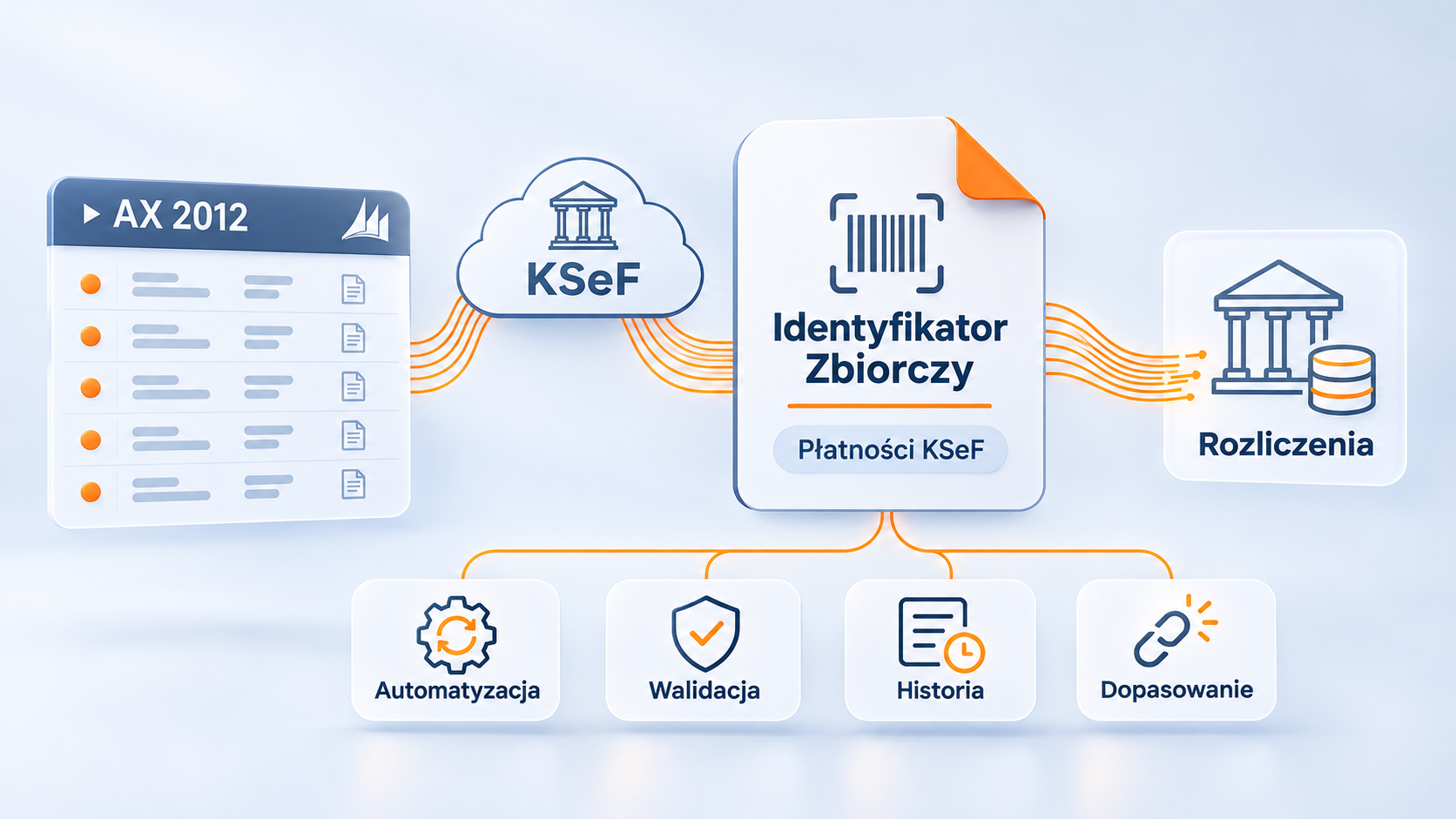
Many invoices. One transfer. One KSeF Collective Identifier.
Handling invoices in KSeF is only one stage of the financial process. The next challenge is ensuring correct invoice identification when making bank transfers and settling incoming payments.
For companies using Microsoft Dynamics AX 2012, this means adapting processes that previously may have relied solely on document numbers and standard settlement mechanisms.
Retcon has developed an extension for Microsoft Dynamics AX 2012 that supports generating and decoding KSeF Collective Identifiers (IZ), preparing payments and linking incoming receipts to the appropriate invoices.
The solution uses existing AX 2012 mechanisms, so IZ handling can become part of the finance team's daily work.
Consider a company that receives dozens of invoices from a single supplier each month. Invoices are posted in AX 2012 and then prepared for payment.
From 1 January 2027, specified B2B payments will require KSeF invoice numbers or a Collective Identifier.
Without an appropriate system extension, employees may have to perform additional tasks: manually finding KSeF numbers, generating an IZ outside the ERP, transferring identifiers into payment details or determining which invoices an incoming bank transfer covers.
The Retcon solution connects these activities with the payment and settlement processes in AX 2012. It reduces manual work and increases control over the flow of information between the ERP, KSeF and the bank.
The extension covers two key parts of the financial process.
The solution uses the standard AX 2012 payment journal and extends it to handle IZ.
The process consists of the following steps:
The KSeF number is used for payment of a single invoice. An IZ can be generated for at least two invoices from the same seller.
Benefit: accountants prepare payments within the familiar AX 2012 environment, without manually copying identifiers between separate applications.
The second area is processing payments received from customers.
When a customer pays several invoices with one transfer and specifies an IZ, the accounting team needs to determine which documents the payment covers.
The Retcon solution supports this process by:
When matching is unambiguous, the mechanisms can reduce manual work. Incomplete data or discrepancies in settlements require suitable controls.
Benefit: instead of manually identifying the invoices covered by a collective payment, accountants can use invoice numbers retrieved directly from KSeF.
The Microsoft Dynamics AX 2012 extension includes features that support daily payment processing and settlement control.
Not every payment should be settled automatically.
Missing KSeF numbers, incorrect IZ identifiers, API outages, differences between the received amount and invoice totals or earlier partial settlement of receivables all require appropriate handling.
The Retcon solution provides validation and mechanisms for handling such cases. Automation does not eliminate accounting controls: transactions requiring a user decision can be referred for manual verification.
Generating and retrieving IZ directly in the ERP reduces the need to search for identifiers and re-enter them manually.
Linking KSeF numbers with incoming payments helps identify which documents are covered by a collective transfer.
Validation helps detect missing information, incorrect invoice groupings and other cases requiring an accountant's attention.
Communication history with KSeF and links between invoices and identifiers support monitoring and analysis of completed operations.
IZ handling can be integrated into existing AX 2012 processes. A company does not need to migrate to Dynamics 365 solely to implement this functionality.
The extension must be adapted to the way an organisation makes payments and processes settlements.
Before implementation, Retcon examines the availability of KSeF numbers, payment journal configuration, bank file formats, bank statement imports and existing receivables settlement rules.
The core scope covers generating and decoding IZ, linking identifiers to invoices, validation and communication history with KSeF.
Bank file adaptations, additional integrations, collective split payments (MPP) and non-standard automation scenarios are agreed individually. The work required depends on the organisation's configuration and requirements.
This approach adapts the solution to real financial processes rather than imposing one payment workflow on every company.
Implementing the Collective Identifier should not be limited to obtaining a number from KSeF. It must also be used throughout the process, from preparing a bank transfer to identifying and settling an incoming payment.
The Retcon solution was designed to connect these activities.
It combines IZ handling with existing Microsoft Dynamics AX 2012 mechanisms, supports the automation of repetitive activities and provides control over data and exceptions.
For organisations using AX 2012, this enables preparation for the KSeF payment requirements of 2027 without rebuilding the entire ERP environment.
Find out how the Retcon solution can improve payments and settlements in your company.
Our experts will analyse your current payment process, the bank file formats you use and the adjustments needed in AX 2012.
Explore the Retcon extension's features and find out how it can be implemented in your organisation.
