Back
Retcon Solution for Dynamics 365 Finance – KSeF Collective Identifier, Payment Automation and Settlement
November 26, 2026
INSIGHT


From 1 January 2027, new KSeF requirements will also cover payment processes. For companies using Microsoft Dynamics 365 Finance, this means ensuring links between invoices, KSeF numbers, bank transfers and settlements.
Having an ERP integration with KSeF does not solve every challenge. The KSeF number must be available not only when issuing and receiving invoices, but also when a company prepares a transfer or identifies a payment received from a counterparty.
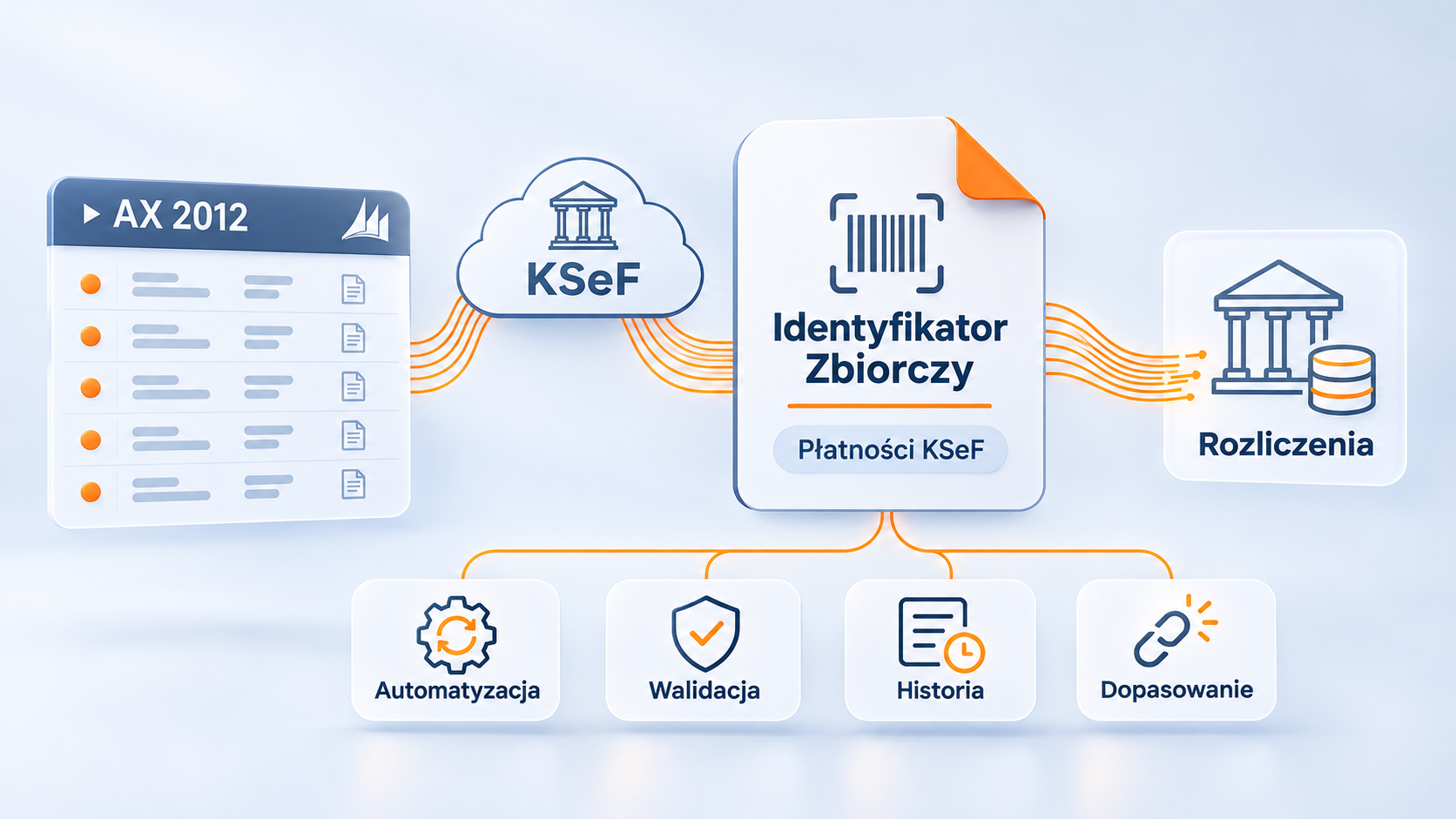
The Retcon solution for Microsoft Dynamics 365 Finance extends existing financial processes by generating and decoding KSeF Collective Identifiers, supporting payment automation and improving invoice identification and settlement.
Consider a company that makes hundreds of supplier payments and receives transfers from many customers every month.
With collective payments, a single transfer may cover several, a dozen or even dozens of invoices.
Without suitable automation, finance team members may have to find KSeF numbers manually, generate Collective Identifiers outside the ERP, copy identifiers into payments and determine which documents an incoming transfer covers.
At high transaction volumes, this means additional work, longer settlement times and a greater risk of errors.
The Retcon solution connects Collective Identifier handling with the processes users already perform in Dynamics 365 Finance. Identifiers therefore become part of the financial workflow instead of a separate task performed outside the ERP.
The extension supports two key areas: preparing supplier payments and settling payments received from customers.
For example, a company wants to pay six invoices from one supplier with a single transfer.
The Retcon solution supports this process in several steps.
The user prepares a payment in the standard Dynamics 365 Finance payment journal and selects the supplier's posted, unsettled invoices.
The solution checks the availability of KSeF numbers and the conditions required to generate a Collective Identifier.
Using the selected KSeF numbers, the system communicates with the KSeF API and obtains a Collective Identifier for the specified set of invoices.
The resulting Collective Identifier is linked to the payment and documents. The system stores communication history, allowing the completed operations to be checked later.
The KSeF number or Collective Identifier can be included in the payment file sent to the bank. The way it is recorded depends on the file format and banking configuration.
Benefit for the finance department: collective payments are prepared using existing Dynamics 365 Finance processes, without manually generating and copying identifiers between separate systems.
The second part of the solution handles payments received from customers.
Suppose a customer has paid several invoices with one transfer and included a Collective Identifier in the payment reference.
The Retcon solution supports the following process:
In unambiguous cases, payment settlement can be automated according to established rules. Cases requiring further decisions can be assigned to a user.
Benefit for the finance department: accountants receive support in identifying invoices linked to a collective payment instead of having to establish them manually through additional correspondence or payment descriptions.
The solution handles Collective Identifiers through communication between Dynamics 365 Finance and the KSeF API.
Users can prepare a set of invoices for payment and obtain a Collective Identifier; after receiving a payment, they can use its identifier to retrieve the related KSeF numbers.
The solution records identifier information in the context of documents and financial transactions.
This makes it easier to determine which invoices a payment relates to, including when one invoice has been included in more than one Collective Identifier.
Before generating a Collective Identifier, the solution checks the relevant conditions, including whether KSeF numbers are available and whether the invoice set meets the requirements.
This helps detect problems early that could otherwise make payment preparation more difficult.
Information on completed operations, statuses, service responses and errors supports process control and problem analysis.
Users and IT teams can more easily determine whether an operation succeeded or needs to be retried or investigated.
Not every payment should be settled automatically.
For example, the amount received may differ from the current invoice balance, a document may have been settled earlier, or KSeF may not return a valid list of invoice numbers.
The solution provides validation and allows such cases to be referred for manual handling, in accordance with the organisation's settlement rules.
Generating and decoding Collective Identifiers within ERP processes reduces the need for additional tools and manual data transfer.
Linking a received identifier to specific invoices makes collective payments easier to process.
Validation and balance checks help identify discrepancies before settlement is completed.
KSeF communication history and links between documents make it easier to analyse transactions, investigate errors and perform internal controls.
The extension works with the system's financial processes, so there is no need to build an entire payment workflow in a separate application.
Retcon offers Collective Identifier capabilities that can be adapted to an existing Microsoft Dynamics 365 Finance environment.
The core scope of the solution includes:
The following may require individual arrangements:
This approach makes it possible to adapt the implementation scope to actual financial processes and reduces the risk of introducing unnecessary changes into a particular environment.
Implementing the Collective Identifier should not simply mean adding another field to the system.
The essential requirement is to ensure a consistent flow of data between invoices, payments, banks and open transactions.
The Retcon solution focuses on the entire financial process, not solely on generating the Collective Identifier.
It connects identifier handling with existing Dynamics 365 Finance mechanisms, supports accounts payable and receivable processes, and enables monitoring of communication with KSeF.
Retcon also analyses the specifics of the customer's environment, bank file formats, payment configuration and settlement rules. This provides the basis for defining the necessary adaptations and test scenarios.
Companies can therefore prepare their financial processes for the new requirements while accounting for the finance team's actual ways of working.
Is your Dynamics 365 Finance system ready to handle KSeF Collective Identifiers from 1 January 2027?
Find out how to improve the preparation of supplier payments, the identification of incoming receipts and invoice settlements.
During a demonstration of the Retcon solution, you will see how Collective Identifiers are generated and decoded, and how the solution can be adapted to your Dynamics 365 Finance environment.