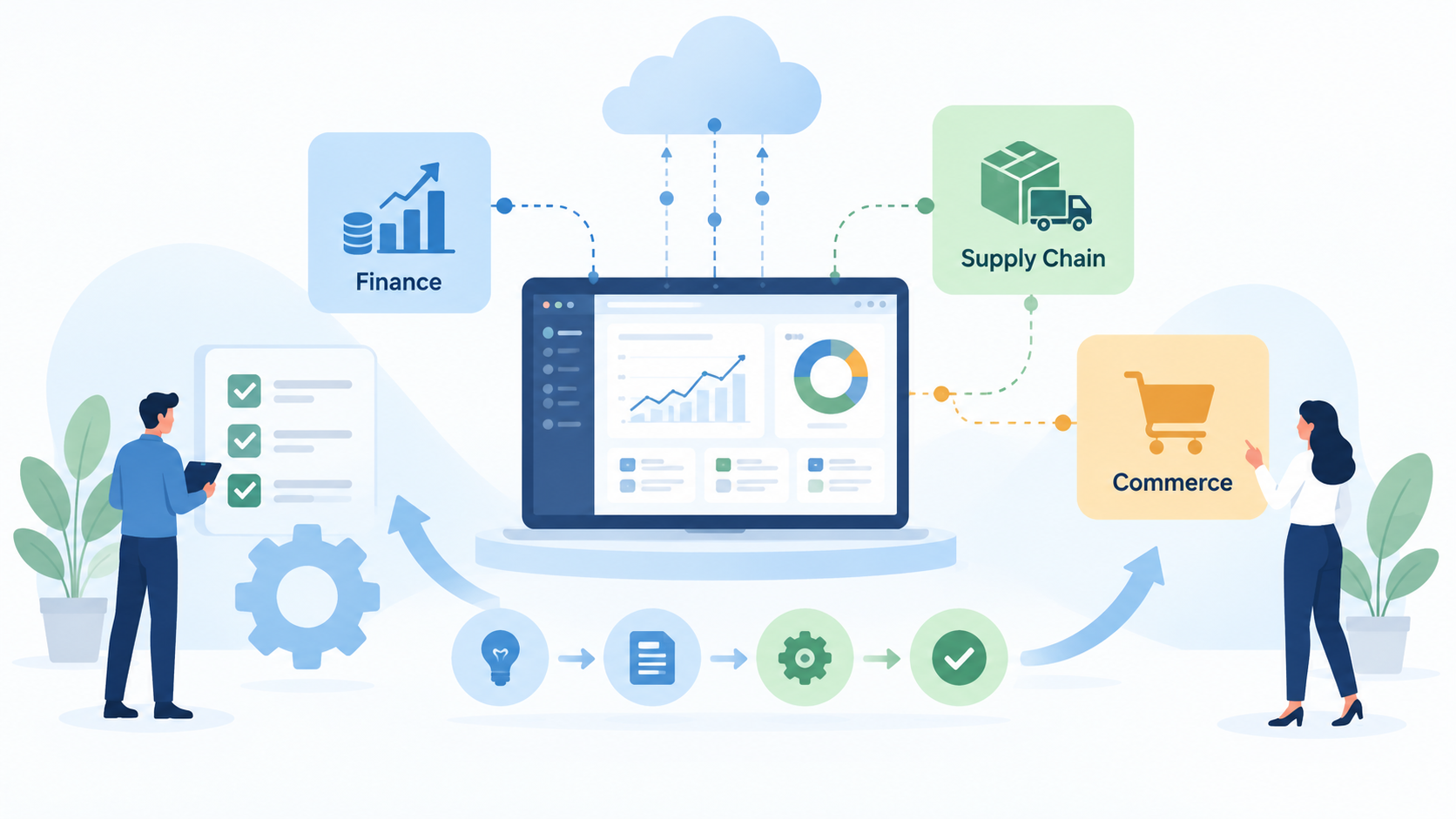
Dynamics 365 Commerce as part of 2026 Release Wave 1 focuses on the consistency of omnichannel experiences, the development of advanced pricing, and the widespread use of AI (Copilot) in sales operations. The key direction is to eliminate silos between sales channels, simplify payment processes and increase the autonomy of the system in data analysis and decision support.
New functionalities include the modernization of POS, the development of payment mechanisms, the centralization of price management and the use of Copilot to analyze sales, customers and products.
Store Commerce (POS)
The POS area is undergoing technological and functional modernization. The interface based on React and Fluent UI increases responsiveness and flexibility while simplifying expansion and customization. Operational functions are also being developed, such as visibility of stock balances between units, support for multiple languages and interface localization.
The result: faster customer service, greater ergonomics and better use of data in real time.
Payments and Checkout
Commerce develops flexible payment models, including support for asynchronous payments and pay-by-link. The system allows payments to be made outside the standard sales flow, which increases conversion and improves the customer experience.
The result: more payment flexibility, higher conversion and better customer service across channels.
Pricing (Unified Pricing Management)
The biggest changes relate to the centralization and automation of price management. A single base currency, advanced price simulations, and extensive mechanisms for managing discounts and pricing policy have been introduced.
The effect: price consistency on a global scale, faster response to market changes and reduced manual labor.
Omnichannel commerce
The system is moving towards full integration of sales channels. Pricing, promotions and customer experience are managed centrally and consistently across all channels (retail, e-commerce, B2B).
The effect: elimination of inconsistencies between channels and better management of the sales strategy.
AI and Copilot
The copilot becomes the analytical and decision-making layer of the system. It supports the analysis of sales, customers, products and financial operations, providing ready-made conclusions and recommendations.
The result: reduced data analysis time, better operational decisions and increased efficiency of sales teams.
March focuses on POS modernization, the use of Copilot and increased payment flexibility.
Store Commerce (POS)
AI and Copilot
Payments
The effect: modern AI-powered POS, faster customer service and greater automation of sales operations.
April develops pricing, omnichannel and advanced payment scenarios.
Payments and Checkout
Pricing (Unified Pricing Management)
Omnichannel commerce
The result: full control over pricing and sales in the omnichannel model and greater flexibility in purchasing and payment processes.
Release Wave 1 2026 in Dynamics 365 Commerce changes the nature of the system from a sales tool to a platform for managing customer experience and business decisions:
This is a shift towards a system that actively optimizes sales and customer experience in real time.
Full list of changes with dates:
https://releaseplans.microsoft.com/en-us/?app=Commerce
If an organization uses Dynamics 365 Commerce and needs to prepare for upcoming changes, analyze the impact of new features or plan a secure deployment, the support of the retcon.pl team allows you to reduce operational risks and accelerate the adoption of new system capabilities.
https://www.retcon.pl/contact