Back
Microsoft Dynamics 365 implementation – what does an ERP project look like step by step?
September 17, 2026
INSIGHT

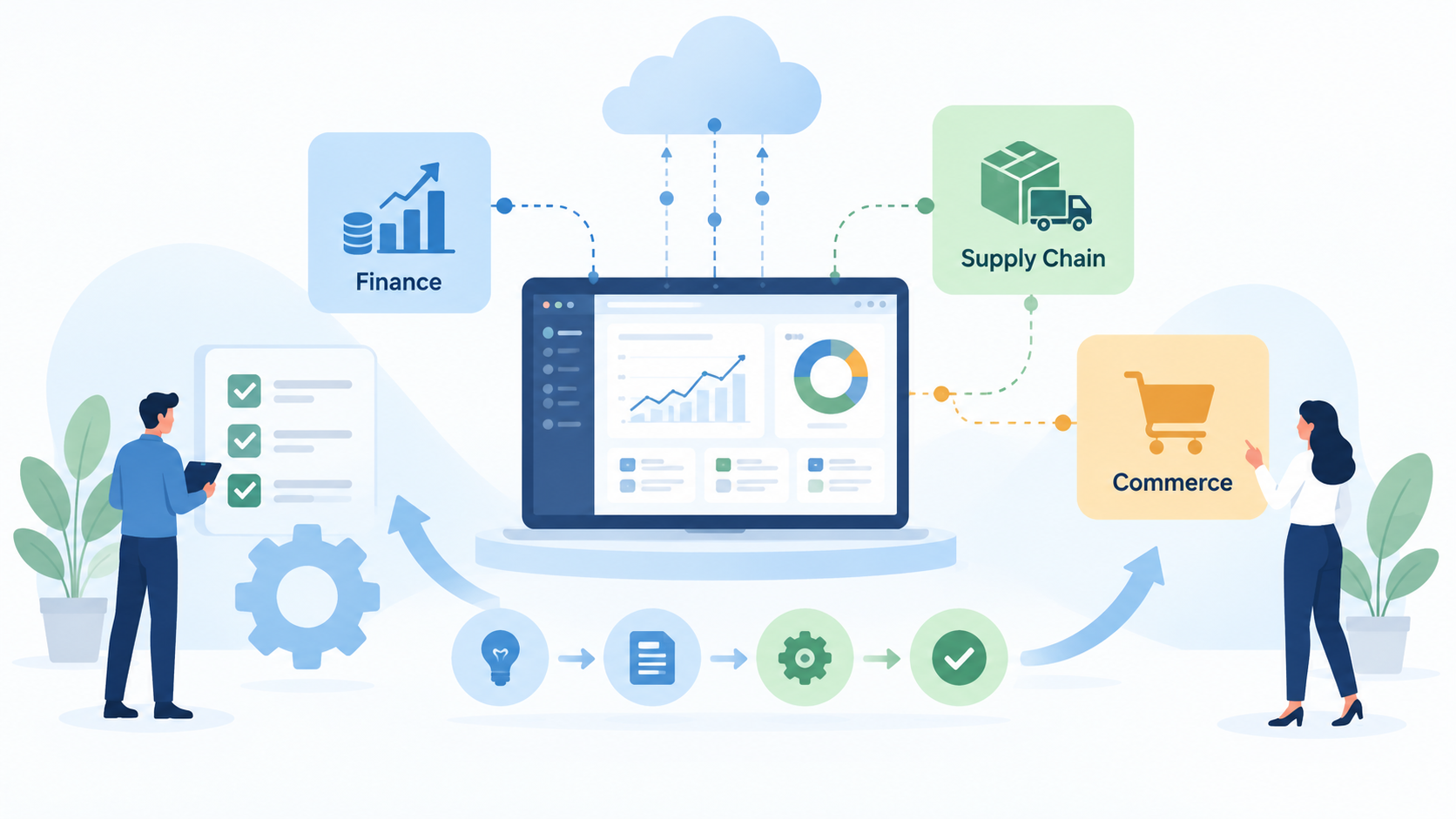
Implementing Microsoft Dynamics 365 is much more than just launching a new ERP system. The project includes business process analysis, defining the solution scope, system configuration, integrations, data migration, testing, and preparing users to work in the new environment.
Depending on the organization's needs, a Dynamics 365 implementation can cover one or more areas: Dynamics 365 Finance, Dynamics 365 Supply Chain Management, and Dynamics 365 Commerce. These individual applications can work together to create a single environment supporting finance, controlling, procurement, logistics, warehousing, production, and retail/omnichannel sales. Microsoft develops these solutions as part of an ERP platform that also utilizes Copilot and AI agents.
A well-executed implementation should primarily address the organization's actual needs. Therefore, before starting system configuration, it is essential to understand the company's processes, define project goals, and determine which requirements can be met by the standard Dynamics 365 functionality and which require additional extensions.
There is no single universal model for a Dynamics 365 implementation that fits every organization. A project covering only the finances of a single company will look different from an international rollout involving multiple entities, warehouses, production processes, retail sales, and integrations with other systems.
Regardless of the project's scale, several key stages can be identified to help organize the implementation process.
The first stage of a Microsoft Dynamics 365 implementation is getting to know the organization and the processes that the new system is intended to support.
The analysis includes, among other things:
At this stage, it is also essential to define the project's business objectives. Implementing Dynamics 365 may be driven by factors such as replacing an older ERP system, standardizing processes across a corporate group, consolidating multiple systems, expanding international operations, or increasing automation.
A well-executed analysis reduces the risk of scope creep during implementation and allows you to focus on the processes that are most critical to the organization.
One of the most important stages of the project is the Fit-Gapanalysis.
Its purpose is to compare the company's business requirements with the standard capabilities of Microsoft Dynamics 365.
FIT refers to a process or requirement that can be handled using the system's standard functionality.
GAP refers to a requirement that the standard Dynamics 365 does not sufficiently address and which may require additional configuration, integration, customization, or a change to the business process.
The goal of the analysis should not be to replicate the previous ERP system one-to-one. It is worth using the implementation as an opportunity to review existing processes.
An excessive number of modifications increases the cost of maintaining the environment and can hinder its future development. Therefore, where business justification exists, it is best to first explore the capabilities of standard Dynamics 365 before designing customizations.
The next step is to determine which areas of the organization will be covered by the project.
Dynamics 365 Finance supports the management of an organization's financial processes, including accounting, accounts receivable, accounts payable, budgeting, fixed assets, cash management, reporting, and financial planning. Microsoft is also enhancing Finance with Copilot features and agents that support specific financial processes.
The implementation of Dynamics 365 Finance can cover a single company or complex environments supporting multiple entities, currencies, and organizational structures.
Dynamics 365 Supply Chain Management supports supply chain processes, including:
Microsoft identifies planning, purchasing and procurement, production, orders, warehousing, and resource management as the key areas of the Supply Chain Management application.
Dynamics 365 Commerce is designed for retail and omnichannel organizations. The solution can integrate processes across brick-and-mortar stores, e-commerce, call centers, and back-office operations. Microsoft describes Commerce as an omnichannel solution that connects the back office, stores, customer service, and digital channels.
The scope of implementation should be based on the actual needs of the organization. Not every company needs to implement all applications at once. In many cases, it is reasonable to phase the project and gradually expand the environment.
Once the requirements and project scope have been defined, the target solution design can be prepared.
At this stage, the following are determined, among others:
For larger organizations, it may also be necessary to plan the implementation across multiple companies or countries. In such cases, it becomes essential to prepare a common process model and determine which elements of the solution will be global and which will be local.
Once the design is approved, the configuration of the actual Dynamics 365 environment begins.
Consultants map the agreed-upon business processes into the system and configure specific areas of Finance, Supply Chain Management, or Commerce.
If the Fit-Gap analysis identified requirements that cannot be met through standard configuration, appropriate extensions are developed at this stage.
This also applies to integrations with other solutions used within the organization, such as banking systems, warehouse solutions, e-commerce platforms, CRM systems, industry-specific solutions, or external data warehouses.
Dynamics 365 can also be extended using other technologies from the Microsoft ecosystem, including the Power Platform.
Data migration is one of the key elements of an ERP implementation.
The scope of migration depends on the organization and the solution previously in use. Data that can be transferred to the new environment includes, among others:
However, simply transferring the data is not enough.
Before migration, you must verify data quality, identify duplicates, and determine how to map data between the old and new systems.
In larger projects, a trial migration is performed before the production launch. This allows you to verify data completeness, process duration, and the accuracy of results before the actual go-live.
The system must be thoroughly tested before launch.
Testing can cover individual features, integrations, and full business scenarios that span multiple areas of the system.
User Acceptance Testing (UAT), which involves the system's future users, is particularly important.
These tests verify whether the configuration matches actual business processes and whether users can perform their tasks in the new environment.
An example of an end-to-end scenario might include creating an order, reserving stock, warehouse release, issuing sales documents, posting the transaction, and including it in financial reporting.
Even a correctly configured system will not deliver the expected results if users do not know how to use it.
Therefore, preparing users for work should be an integral part of the implementation.
Depending on the project model, training can be conducted directly for end users or for a group of key users who then support others in the organization.
It is also essential to prepare the organization for process changes. A new ERP often changes not only the system interface but also individual responsibilities, information flow, and the way daily tasks are performed.
Once configuration, trial migrations, testing, and training are complete, the production launch takes place.
Before go-live, a transition plan, known as a cutover plan, is prepared.
It may include:
For large organizations, the transition to Dynamics 365 can be carried out in stages – for example, by company, country, or business area.
Go-live does not mean the end of work with the system.
The initial period after launch is used to stabilize the environment and resolve any issues that may arise during actual user operations.
After the stabilization period, Dynamics 365 can be further developed in line with changes occurring within the organization.
This may include additional companies, processes, integrations, automations, and new features provided by Microsoft.
There is no single implementation timeline that applies to all projects.
The project duration is primarily influenced by:
A project covering a single Finance area will have a different scale than an international implementation of Finance, Supply Chain Management, and Commerce carried out across multiple organizational units.
Therefore, the schedule should be determined after analyzing the project scope, rather than based on a universal deadline.
The cost of a Dynamics 365 implementation follows a similar logic.
The project budget is influenced by, among other things:
Microsoft Dynamics 365 licenses represent a separate cost component. Individual Dynamics 365 applications are licensed according to the relevant Microsoft models and plans.
Therefore, an accurate implementation quote should be preceded by defining the business and technical scope of the project.
Implementing Dynamics 365 often involves migrating from earlier versions of Microsoft Dynamics AX.
In such projects, analyzing existing modifications, integrations, and data becomes particularly important. Not all solutions previously created in AX should be automatically transferred to the new environment.
Migration is a great opportunity to evaluate whether a given feature is still needed and whether it is now available as part of the standard Dynamics 365 functionality.
Retcon also has experience with large-scale projects of this type. The team successfully completed a project involving the implementation of Dynamics 365 Finance and the migration of over 500 entities from Microsoft Dynamics AX 2012, as part of an international ERP transformation program.
Our experience also includes projects transitioning from Dynamics AX to Dynamics 365 Finance for organizations such as Rödl & Partner.
When implementing Dynamics 365 in Poland, local tax and reporting requirements must also be taken into account.
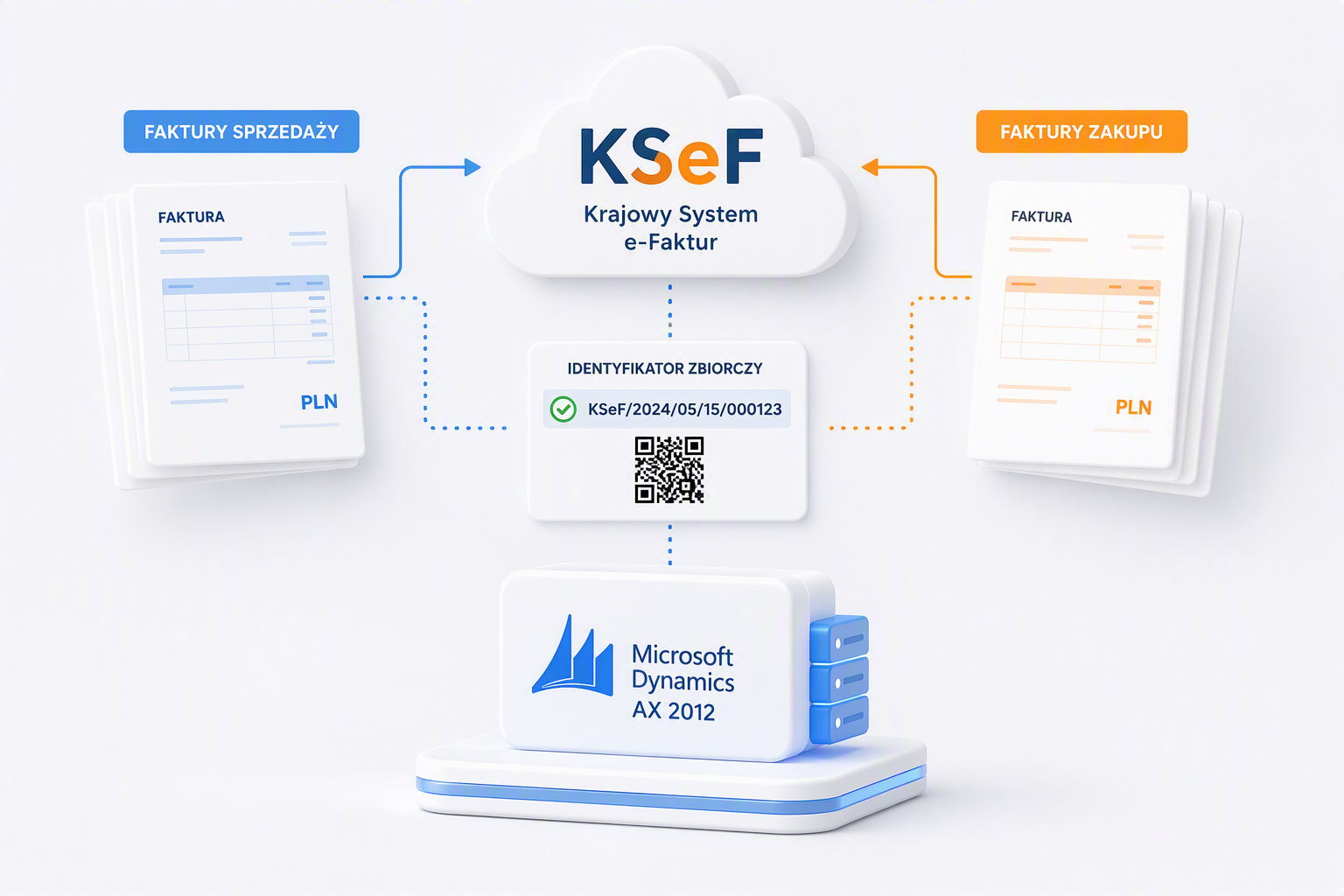
This includes, among others, KSeF, JPK, and other processes resulting from Polish regulations.
Retcon develops its own localization solutions for Microsoft Dynamics 365 Finance & Operations, including KSeF, JPK, Split Payment, and VAT White List support.
Accounting for local requirements during the analysis phase helps avoid situations where key compliance elements are added only just before the system goes live.
The development of Dynamics 365 is increasingly focused on leveraging artificial intelligence within ERP processes.
Microsoft is developing Copilot and AI agents for applications including Dynamics 365 Finance and Supply Chain Management. In Finance, features are available to support analysis, planning, and the automation of various financial operations, while in Supply Chain Management, artificial intelligence assists with tasks such as supply chain planning and related processes.
In practice, this means that when designing a new environment, it is worth looking not only at mapping current processes but also at which tasks could be automated or supported by AI in the future.
The choice of an implementation partner has a direct impact on the course of the project.
When making your selection, you should primarily check:
A partner should also be able to identify situations where using the Dynamics 365 standard is a better solution than creating another customization.
Retcon delivers Microsoft Dynamics 365 projects in the areas of Finance, Supply Chain Management, and Commerce, supporting organizations with new implementations, migrations, and the development of existing environments.
The scope of work can include process analysis, solution design, Dynamics 365 configuration, development, integrations, data migration, testing, go-live, and ongoing system support.
Retcon’s experience spans both projects for individual organizations and complex international environments. Among other initiatives, the company led a Dynamics 365 Finance implementation project involving the migration of over 500 entities from Dynamics AX 2012.
Such projects require a combination of technological expertise and a deep understanding of business processes. Only then can Dynamics 365 become a cohesive environment that supports organizational growth, rather than just a new version of an existing ERP system.
Implementation includes business process and requirements analysis, project scoping, system configuration, development of extensions and integrations, data migration, testing, user training, and go-live.
The implementation timeline depends on the project scope. Factors such as the number of applications, entities, processes, integrations, extensions, and the volume of data to be migrated all play a role. A schedule should be established following a requirements analysis.
The cost depends primarily on the functional scope, the number of users and entities, required integrations, data migration, extensions, and services related to analysis, configuration, testing, and training. The budget must also account for the relevant Microsoft licenses.
Yes. Dynamics 365 applications can be implemented according to an organization's specific needs. A project can start with Dynamics 365 Finance and subsequently be expanded to include Supply Chain Management, Commerce, or other solutions.
No. The scope and sequence of implementation depend on the organization's business processes and strategy. For some companies, a joint implementation is justified, while for others, a phased rollout is a better solution.
Yes. However, migrating from Dynamics AX 2012 to Dynamics 365 requires an analysis of existing processes, modifications, integrations, and data. The project should determine which elements to migrate, which to replace with standard Dynamics 365 functionality, and which to rebuild.
Fit-Gap is an analysis that compares an organization's business requirements with the standard capabilities of Dynamics 365. FIT refers to requirements that can be met by standard functionality, while GAP identifies areas that require process changes, configuration, integration, or extensions.
Before starting the project, it is worth defining business goals, process owners, the scope of implementation, and the project team. You should also begin analyzing data for migration, integrations, and local requirements. The earlier an organization engages key users, the easier it is to verify processes before system configuration.
Planning to implement Microsoft Dynamics 365?
Talk to our team about the project scope, module selection, and preparing your organization for implementation.
Email: marketing@retcon.pl
Let's talk about your Dynamics 365 implementation